In a search for “trends” upon multiple education and academia websites, the topic of AI dominates the articles listed.
From University World News:
- Universities issue own rules to curb AI-assisted theses
- AI-assisted writing is quietly booming in academic journals
- Open-source LLMs – AI researchers are spoiled for choice
- Integrating AI in academic research – Changing the paradigm
- ‘A’ and ‘I’ the mantra at this year’s ASU+GSV edtech summit
- 2024 ASU+GSV Summit explores the AI revolution in education
- AI and HE around the world – Evolution and revolution?
- Research explores how AI might change knowledge production
From Google, when searching on “trends in adult education 2024”, the searcher is presented with the following:
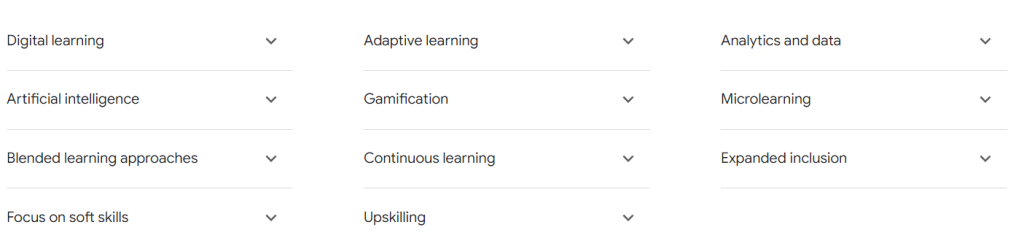
Near the top of that list is Artificial Intelligence, which should not be surprising. AI isn’t something that is coming in five years, it’s being used to do homework, write papers, and even write lesson plans. There’s fear and concern over how AI will affect assessment and grading. Within the Computer Science department, I work on getting the students building applications that leverage the AI tools, as these types of integrations are what they’re likely going to see once they get out into industry.
In addition, many of the other items are also often discussed at the college level within the School of Trades and Technology and the Computer Science department:
- Digital learning
- Adaptive learning
- Blended learning approaches
- Gamification
- Microlearning
- Continuous Learning
- Focus on Soft Skills
- Upskilling
Digital learning is ubiquitous within the computer science department, with the use of online tools and the online learning portal “D2L (Desire 2 Learn)”. This topic will only become more prominent with the advancement of AI and better interactive online tools
Adaptive learning, where courses are tailored to the individual, certainly is a topic that is discussed. While our content is set as per the course learning outcomes, often we can adapt the course to the learners’ preference in pacing and preferences in learning styles.
Hybrid education is often taught within our classes, even though we say that we’re teaching face-to-face. Many of the labs are posted online and are self-paced asynchronous lessons that may or may not have a strict due date. Often, these labs have video content which complement the text content.
Through gamification, we can engage the younger adult learner who is not as intrinsically motivated as 24+ year-olds. Currently, in development, is the Kode.GURU platform, an e-learning gamification of course content that I teach. The goal is to make regular practice fun, so that the students build a stronger foundation of understanding, faster.
Microlearning is certainly something we discuss in the department, with man of our courses being broken down in to modules to make it easier for learnings to break down and retain information.
Within our diploma programs, we are teaching the students relevant skills for todays work-force, however we’re also building in the skills necessary to know how to learn on their own, enabling the students to be life-long learners
Without soft-skills, our students would not be employable — while software developers have been known to work in a vacuum, todays work force is about being able to work within teams which requires the ability to communicate effectively.
And lastly, there has been much discussion within our own department on creating either micro-credentials or associate or extended degrees or diplomas to allow our students to continually be upgrading their skills even after they’ve completed a primary diploma.
For further reading on some of the trends of 2024, please see:
Leave a Reply